
The Perryville National Cemetery is the only national cemetery to be constructed, dismantled, reestablished on a different site without any burials, and finally transferred to a state government. What is its legacy and story?

The Battle of Perryville was Kentucky’s largest and bloodiest Civil War battle. Fought on October 8, 1862, the five-hour encounter resulted in a Union victory and the expulsion of the Confederacy from the state for the rest of the war. Over 7,000 soldiers were killed, wounded, or captured, and soldiers from the Army of the Ohio were tasked with hastily burying the Union dead where they fell.[1]
After the end of the Civil War in 1865, burial teams under the command of Colonel R. N. Batchelder returned to this hallowed ground and other locations around Perryville and exhumed the bodies of roughly 970 Union soldiers. The remains were reburied atop what is known as Peters Hill, a site fought over twice during the battle.[2] The three-acre square plot was divided into eight burial sections with a central circle intended to hold a monument.[3] It was surrounded by a stone wall five feet high and two feet thick, and a cottage for a caretaker was located outside the gate along the Perryville-Springfield Turnpike.
However, by 1869, the U.S. government again exhumed the remains at the Perryville cemetery and relocated them to the Camp Nelson National Cemetery near Nicholasville, Kentucky.[4] The removal was reported to have occurred due to a dispute over land ownership. However, other sources allege that the expense of maintaining multiple scattered national cemeteries and other burial lots in Kentucky—11 in total—was too much, and, thus, a decision was made to consolidate. Similar efforts took place across the South in the years following the Civil War, as thousands of Union dead hastily interred near where they died were exhumed and moved to newly established national cemeteries.
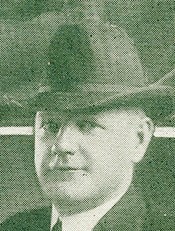
In March 1927, Kentucky Representative Ralph W. Emerson Gilbert pushed a bill through the U.S. House of Representatives to reestablish a national cemetery at the Perryville battlefield. Gilbert hoped that, over time, the Federal government would use the national cemetery to establish a military park. The bill moved slowly through Congress, but on March 3, 1928, the War Department was authorized to accept, free of cost, about four acres of land owned by the Perryville Battlefield Commission located adjacent to a Confederate cemetery. In addition, $5,000 was appropriated for a “tablet or marker … in honor of the Federal soldiers who took part in that battle.” The acreage was transferred almost three years later in January 1931.

On October 8, 1931, on the 69th anniversary of the battle, a large crowd gathered at the “Perryville National Cemetery” to commemorate the event with the dedication of a tall granite obelisk. Speeches were made and the 10th U.S. Infantry, under the command of Colonel F. S. Young, drilled and performed military maneuvers on the battlefield. Others in attendance included numerous Civil War Veterans, some of whom fought in the battle, and Kentucky Governor Flemon Davis Sampson.[5]
Though dedicated as a “national cemetery,” there were never any burials there nor was it Representative Gilbert’s intent that it be a cemetery. There were already six national cemeteries in Kentucky, and the location and terrain were not suited for cemeterial purposes. Within a decade, the War Department was actively seeking to dispose of the national cemetery, writing to the Secretary of the Interior in March 1941 about taking on the maintenance and administration of the property as a historic site. The Interior Department was not interested. Nothing more was done at the time, and the matter was dropped as the United States entered World War II.
It was not until early 1947, that the War Department again looked to dispose of the property. A letter was drafted to Kentucky State Parks, which had acquired the larger property from the Perryville Battlefield Commission, asking if they would consider taking the property. The State Parks director responded that any attempt to return the “cemetery” would likely face opposition as persons living in that part of the state envisioned the Federal government taking over the entire battlefield to develop and operate it as a national battlefield park like those at Gettysburg and Antietam.
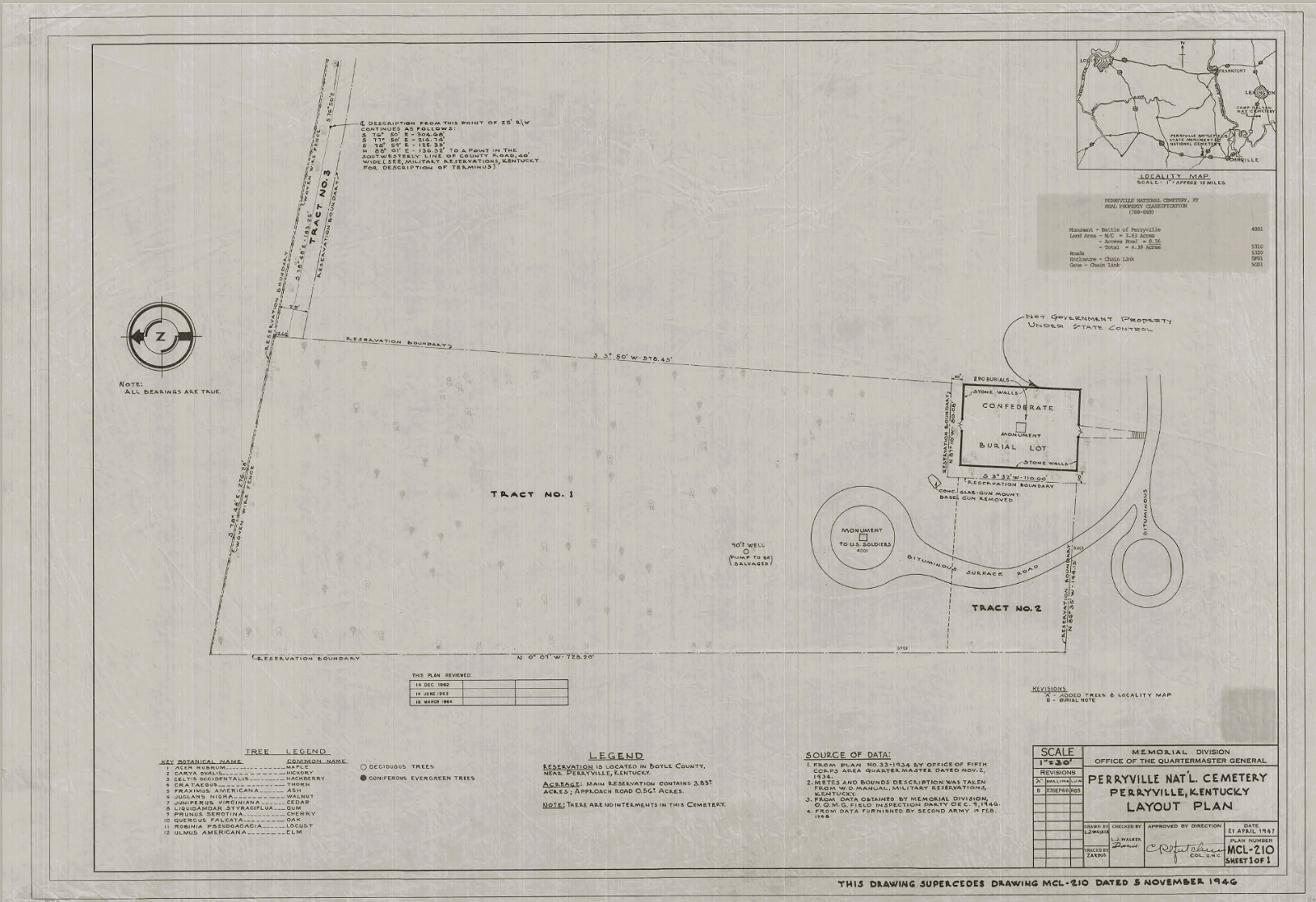
Two years later, the Federal government made plans to dismantle the monument, move it to Camp Nelson, and dissolve the national cemetery. The Senate approved a bill to make these changes along with ones affecting five other national cemeteries. However, when it reached the House, Kentucky Congressman Thomas Underwood, at the behest of civic leaders in Perryville, advocated for the Perryville National Cemetery language to be stricken from the bill. The Army made no further attempt to dispose of the property. In 1973, after the passage of the National Cemeteries Act, the cemetery was transferred from the U.S. Army to the Veterans Administration (VA). In 1978, the Kentucky legislature called on VA to transfer the property into the state parks system, and, after a long debate, the property was officially donated to the state. Today, it is known as the Perryville Battlefield State Historic Site.
[1] Center College Data Base, Battle of Perryville Stats and Facts. https://sc.centre.edu/sc/special/perryville/facts.htm
[2] “Perryville National Cemetery.” Louisville Journal. November 23, 1866, page 4. https://www.newspapers.com/image/1128246682/?match=1; Polk, J.J., “Autobiography of Dr. J. J. Polk.” 1867. United States. Library of Congress. https://www.loc.gov/resource/gdcmassbookdig.autobiographyofd00polk/?sp=5&st=list
[3] “Perryville National Cemetery.”
[4] Noe, Kenneth W. “Remembering Perryville: History and Memory at a Battlefield.” Auburn University. April 14, 2001. https://www.perryvillebattlefield.org/Noe-battlefield.pdf; “From Marion County.” The Louisville Daily Courier. October 29, 1867. https://www.newspapers.com/image/119289831/?match=1&terms=Perryville%20National%20Cemetery%20
[5] “Union Monument Dedication October 8, 1931.” Perryville Battlefield. https://www.perryvillebattlefield.org/html/union_monument_1931.html: “Great Crowd gathers at Battlefield.” Kentucky Advocate, October 9, 1931. Newspapers.com. https://www.newspapers.com/image/1043308808/?match=1&terms=Perryville%20National%20Cemetery%2C%20Col.%20Young%20
By Taylor Bishop
Virtual Student Federal Service Intern, VA History Office
Share this story
Related Stories
Featured Stories
A Brief History of the Board of Veterans’ Appeals
On July 28, 1933, President Franklin Delano Roosevelt signed Executive Order 6230 creating the Board of Veterans’ Appeals (BVA). The BVA was created as part of the Veterans Administration (VA), which had been established only three years earlier.
Featured Stories
The Fall of Saigon 1975: A South Vietnamese Military Physician Remembers
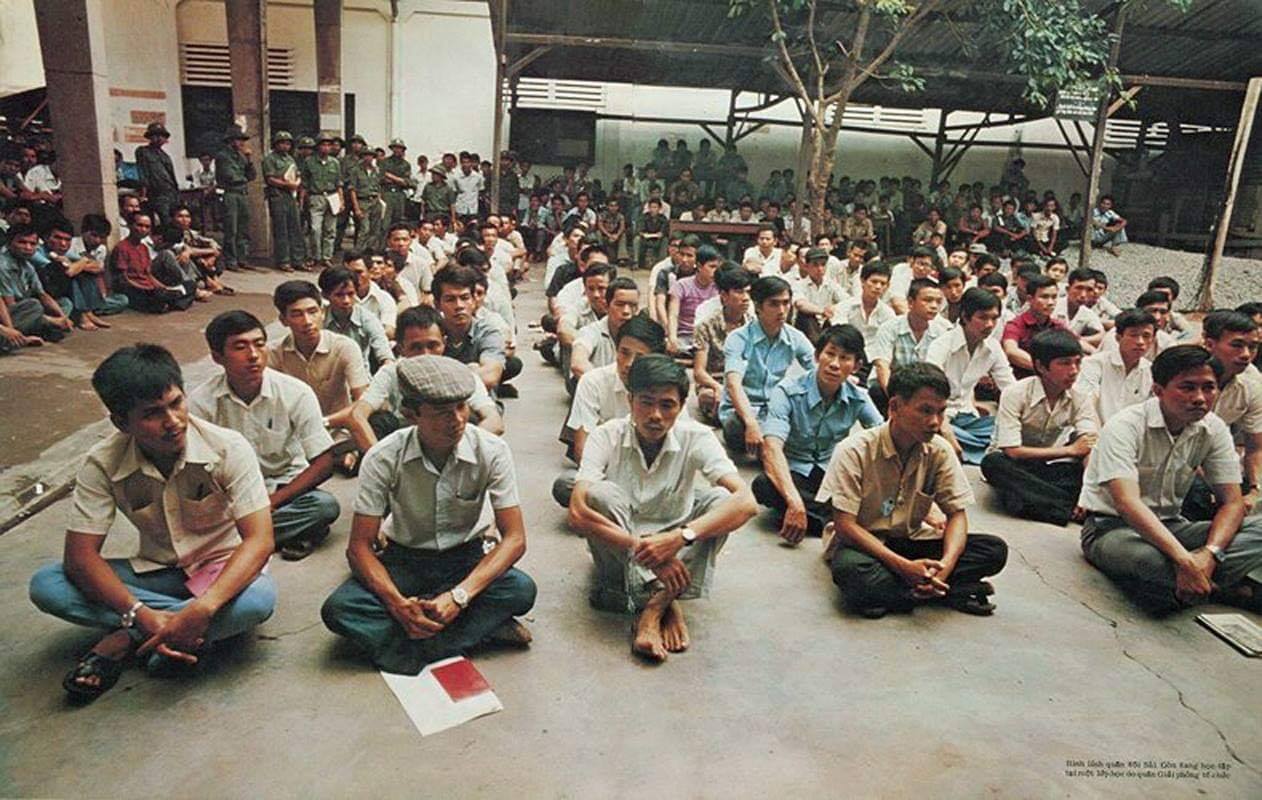
"There was chaos in the streets when I made my way to the hospital on the morning of April 30, 1975. In a place of order, there was now great confusion. The director and vice director of the hospital were gone, making me, the chief of medicine, the highest-ranking medical officer."

Featured Stories
History of Former Whipple VA Directors Schmoll And McIntyre
Leadership change is something that happens constantly, whether it’s due to promotion, health, or other circumstances. At the Department of Veterans Affairs’ Northern Arizona Medical Center (formally known as Whipple VA Hospital) in Prescott, Arizona, directors have stayed in their position on average, three to five years. The shortest stint was 22 months, the longest was 16 years and two months. Most former directors moved on and retired elsewhere. However, two former directors, Paul N. Schmoll and Virgil I. McIntyre, either returned to or stayed in Prescott following their retirement. Both men are laid to rest at local cemeteries in the Prescott, Arizona, area.