
This story is part of our series celebrating America’s 250th anniversary. Find more captivating stories from the VA History Office at America 250.
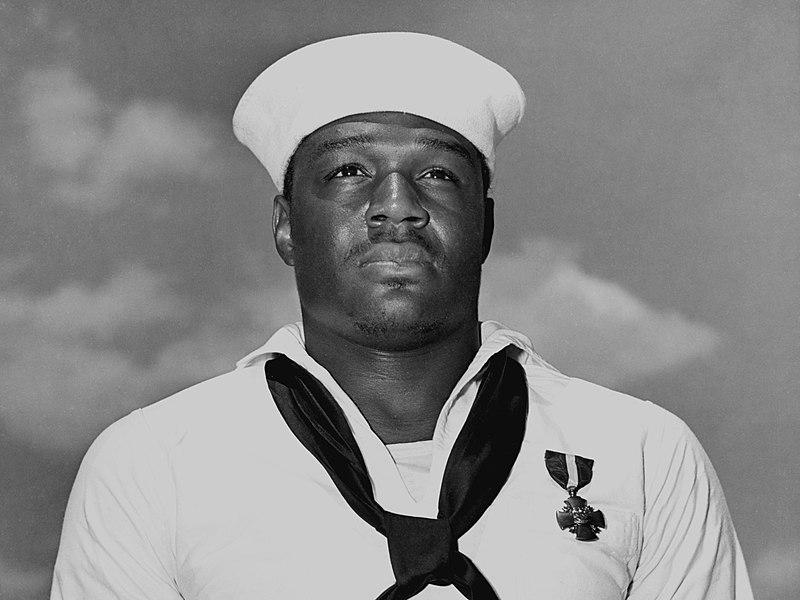
Born October 12, 1919, in Waco, Texas, Miller joined the Navy in 1939 as a mess attendant one of the only occupational specialties then open to a Black man. In January 1940, he was assigned to the battleship USS West Virginia (BB 48), stationed at Pearl Harbor. Severe damage to the ship during the early phases of the December 7th attack prevented Miller from manning his assigned battle station. Seeking to help where he could, he was ordered to the ship’s bridge to help move his captain, Mervyn Bennion, mortally wounded with shrapnel in his abdomen.
Doris Miller was then ordered to the port side anti-aircraft guns to load ammunition for an officer. After performing this task, Miller, on his own initiative, loaded and manned an unattended gun and fired at incoming Japanese planes. Although untrained, he laid down effective fire and stopped firing when he ran out of ammunition and the ship began to sink. Even then, he persisted in helping his fellow sailors to safety until he finally made his way to shore.1 Miller, himself, escaped injury and was reassigned to the cruiser Indianapolis (CA 35).
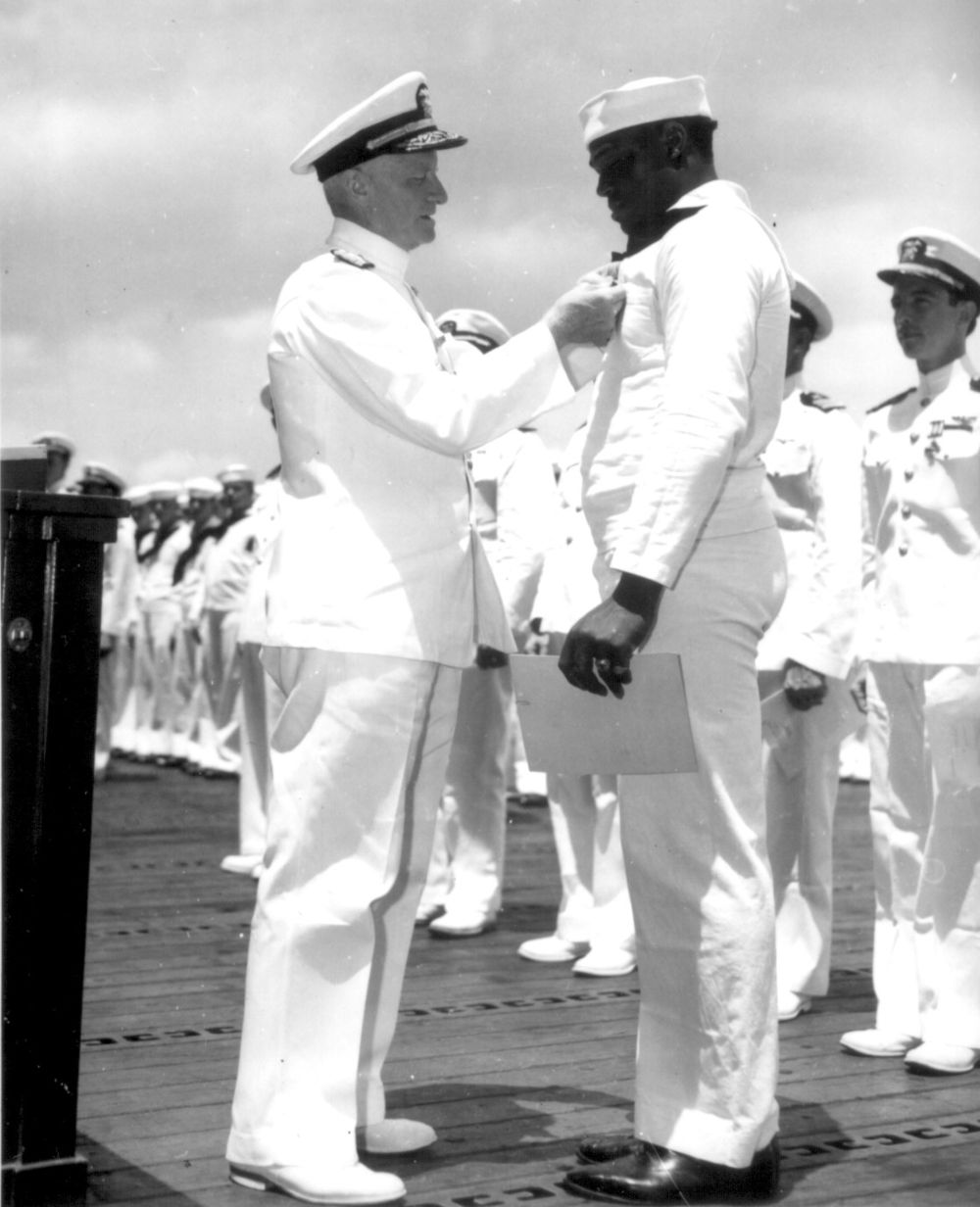
Initially commended only as an unnamed Black man, pressure from the NAACP led to Doris Miller’s identification and the presentation of an award. On April 2, 1942, Miller’s efforts on the West Virginia were dramatized on the CBS radio series, They Live Forever.2 Although Congressional bills and other calls to grant Miller the Medal of Honor failed, President Franklin D. Roosevelt approved awarding Miller the Navy Cross. Admiral Chester Nimitz, Commander-in-Chief, Pacific Fleet, presented the Navy Cross to Miller on board the USS Enterprise (CV-6) on May 27, 1942.
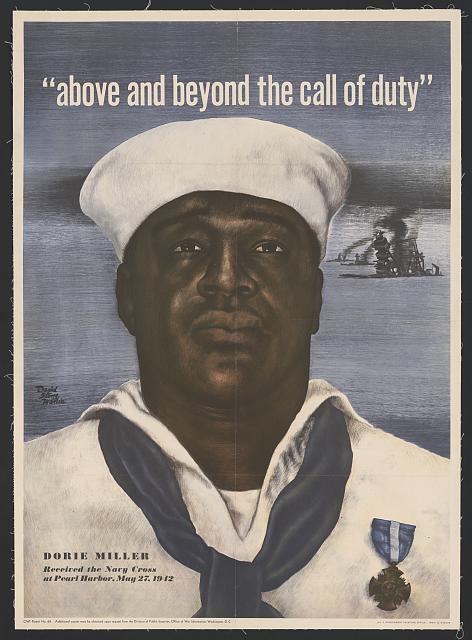
The Navy detached Miller to participate in a War Bond tour with White war heroes from December 1942 to January 1943, making him the first African American allowed on the speaking tour.3 Furthermore, his portrait appeared in a 1943 Navy recruiting poster under the words “above and beyond the call of duty.”4
Miller was assigned to the escort carrier USS Liscome Bay (CVE 56) in June 1943 and returned to the war.5 His ship was struck by a torpedo fired from a Japanese submarine on November 24, 1943, during the Battle of Makin in the invasion of the Gilbert Islands. The explosion detonated the ship’s aviation bomb magazine creating a devastating explosion. The ship sank in 23 minutes. Over 600 of a crew of 900 were lost, including Miller. His parents were notified of their 24-year-old son’s loss on the second anniversary of Pearl Harbor.
While begrudgingly recognized, Doris Miller became a role model and served as a rallying cry for desegregation in the United States Armed Forces. Miller was not keen on the national attention and cautiously optimistic about the standing of African Americans in the military in the future. In one of his few letters to the Pittsburgh Courier he wrote, “you have opened up a little for us, at least for the ones who were following me, and I hope it will be better in the future.”6
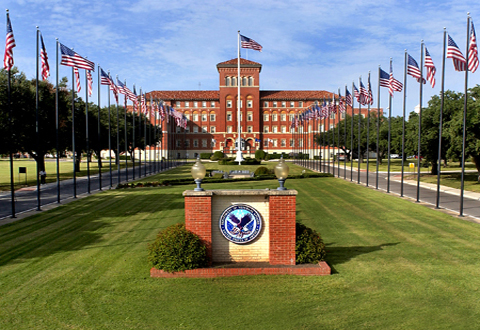
Since his death nearly 80 years ago, Doris Miller continues to be recognized posthumously for his patriotism and extraordinary bravery. Two more recent examples are: On December 18, 2014, the Department of Veterans Affairs (VA) honored Miller for his heroism by naming the VA medical center in Waco, Texas, after him.7 On January 19, 2020, the U.S. Navy announced construction of the aircraft carrier USS Doris Miller (CVN-81), an honor traditionally reserved for U.S. Presidents or other high ranking individuals.8 The ship is scheduled to be commissioned in January 2030.
Footnotes
- Cutrer, Thomas W., and T. Michael Parrish. “How Dorie Miller’s Bravery Helped Fight Navy Racism.” Navy Times, January 20, 2020, sec. Salute to Veterans. ↩︎
- Doris Miller – Wikipedia. ↩︎
- Doris Miller, Military History Fandom Wikipedia. ↩︎
- 1943 U.S. Navy recruiting poster featuring Miller and his Navy Cross. ↩︎
- Cutrer and Parrish. ↩︎
- Ibid. ↩︎
- Flores, Bill. “H.R.4199 – 113th Congress (2013-2014): To Name the Department of Veterans Affairs Medical Center in Waco, Texas, as the ‘Doris Miller Department of Veterans Affairs Medical Center’” December 18, 2014. 2013/2014. ↩︎
- Doris Miller Wikipedia, from LaGrone, Sam (January 18, 2020). “Next Ford-class Carrier to be Named After Pearl Harbor Hero Doris Miller”. USNI News. Retrieved January 18, 2020. ↩︎
Share this story
Related Stories

Featured Stories
Veterans’ Horticultural Pursuits at the Dayton National Home for Disabled Volunteer Soldiers
Veterans living at the Dayton, Ohio, National Home for Disabled Volunteer Soldiers (NHDVS) played an integral role in beautifying the 578-acre campus. Veterans reaped benefits from working on the land including improved physical and mental health, social cohesion, and occupational skills. Most importantly, tending gardens provided Veterans with a sense of purpose and pride for enhancing their facility’s appearance.
Featured Stories
The 3rd Massachusetts Cavalry Monument in the Year of the Fire Horse
In the southwest quadrant of Winchester National Cemetery, located in the town of the same name in Virginia, sits an impressive monument to the 3rd Massachusetts Cavalry that pays tribute to both man and beast. The monument is adorned with a bas-relief of a horse’s head, wild-eyed and straining at its bridle. As February 2026 marked the start of the Lunar New Year and the Year of the Horse, this is an opportune time to explore the history of the regiment and its monument. According to Chinese astrology, the horse is hard-working, agreeable, and courageous, although it also chafes at being controlled by others, something the men of the 3rd Massachusetts Cavalry experienced firsthand. Stated one soldier, “The taming of wild animals was something I did not dream of when I enlisted in '62.”
Featured Stories
The Declaration of Independence and the First Veterans Benefits
The Declaration of Independence and the first Revolutionary War benefits act were both approved 250 years ago during the tumultuous summer of 1776. These events were linked. Delegates to the Second Continental Congress waited until they had settled the question of independence before deciding how to treat the citizen-soldiers wounded in service to the Nation.